Kitchen
Best Mixer Grinder for an Indian Kitchen
Updated 4 November 2026
Top Picks at a Glance

Bosch TrueMixx Pro 1000 W Mixer Grinder, 4 Jars (MGM8844BIN)
1000 W · 4 jars · Pounding blade · Lid locks, suction feet
Check Price on Amazon
Sujata Dynamix 900 W Mixer Grinder, Double Ball Bearing, 22,000 RPM
900 W · Double ball bearing · 22,000 RPM · 90 min non-stop
Check Price on Amazon
Preethi Titan 1000 W Mixer Grinder, 3 Stainless Steel Jars
1000 W · 3 jars · SIGMA W2 motor · 3D air cooling
Check Price on AmazonEvery mixer grinder advertises wattage, and wattage is the least useful number on the box. A 750W mixer with a copper-wound motor, ball bearings and a proper overload cut-out will outlast a 1000W mixer built to a price — and it will grind dry masala just as well.
What actually decides whether a mixer survives an Indian kitchen is how it handles three jobs: wet grinding in volume (idli and dosa batter), dry grinding without heat (turmeric, garam masala, chutney pudi), and small-batch chutney where a big jar simply does not work.
This guide explains what 750W and 1000W really buy you, which jars matter, and the seven machines worth buying at each price — including the two that are genuinely built for daily batter grinding.
The picks
Ordered from best all-rounder down to specialist picks. Prices are approximate and were checked on the date shown on this page — always confirm on Amazon before ordering.
Bosch TrueMixx Pro 1000 W Mixer Grinder, 4 Jars (MGM8844BIN)
Best for: A family that grinds everything — batter, masala and chutney
Key specifications
- Specification 1
- 1000 W
- Specification 2
- 4 jars
- Specification 3
- Pounding blade
- Specification 4
- Lid locks
- Specification 5
- suction feet
Pros
- The blunt pounding blade is the one real design difference here: it crushes dry ingredients instead of slicing them, which gives masala a coarser, more traditional texture.
- Lid locks and suction feet mean it stays put and does not need a hand on the lid while it runs.
- Hands-free operation, cable management and a concealed bush for the coupler — the details that stop a mixer from rattling itself apart.
Cons and checks
- The fourth jar is a juicer jar; if you never juice, the three-jar machines below save you money.
Guide price: ₹5,699. Checked 4 November 2026; confirm the current price on Amazon.
Sujata Dynamix 900 W Mixer Grinder, Double Ball Bearing, 22,000 RPM
Best for: Idli and dosa batter in bulk, week after week
Key specifications
- Specification 1
- 900 W
- Specification 2
- Double ball bearing
- Specification 3
- 22
- Specification 4
- 000 RPM
- Specification 5
- 90 min non-stop
Pros
- The highest-rated mixer on this list — 4.5, and Sujata’s reputation in Indian kitchens is built on exactly this job.
- Rated for 90 minutes of non-stop running, which is the honest test of whether a mixer can handle batter duty.
- Double ball bearings and 22,000 RPM keep the motor smooth under a full wet jar.
Cons and checks
- The most expensive pick here, and it is a workhorse rather than a feature list — no fancy displays or preset modes.
Guide price: ₹7,090. Checked 4 November 2026; confirm the current price on Amazon.
Preethi Titan 1000 W Mixer Grinder, 3 Stainless Steel Jars
Best for: Dry masala and chutney powder in quantity
Key specifications
- Specification 1
- 1000 W
- Specification 2
- 3 jars
- Specification 3
- SIGMA W2 motor
- Specification 4
- 3D air cooling
Pros
- High-torque 1000 W SIGMA motor, and Preethi’s blade design is tuned for hard, dry ingredients like turmeric and dals.
- 3D air cooling keeps the motor from cooking itself during long dry grinds — the real reason 1000 W machines exist.
- Three jars rather than four: no juicer filler, and the price reflects it.
Cons and checks
- Fewer jars than the Bosch at a similar price — pick it for the motor and the dry-grind performance, not the accessory count.
Guide price: ₹5,107. Checked 4 November 2026; confirm the current price on Amazon.

Atomberg Zenova Mixer Grinder, Intelligent BLDC Motor, 4 Jars
Best for: Anyone who grinds daily and cares about the electricity bill
Key specifications
- Specification 1
- BLDC motor
- Specification 2
- Grinds like a 1000 W
- Specification 3
- 4 jars
- Specification 4
- Coarse mode
Pros
- BLDC motors use less power for the same grinding, run cooler, and Atomberg builds them as its core product rather than as a side line.
- A dedicated coarse mode is genuinely useful for chutneys and masalas where you want texture, not powder — like sil-batta or ammikallu grinding.
- The listing claims 1000 W-class grinding, and the 4.2 rating suggests buyers agree.
Cons and checks
- Not a 1000 W motor in the conventional sense — if you specifically want brute-force wattage for batter, the Sujata is the safer buy.
Guide price: ₹7,199. Checked 4 November 2026; confirm the current price on Amazon.

Philips HL7756 Mixer Grinder, 750 W, 3 Stainless Steel Jars
Best for: A normal family kitchen that grinds chutney and masala daily
Key specifications
- Specification 1
- 750 W
- Specification 2
- 3 jars (1.5 L
- Specification 3
- 1 L
- Specification 4
- 0.3 L)
- Specification 5
- 5-year motor warranty
Pros
- The cleanest spec sheet under ₹3,200: wet, multipurpose and chutney jars, three speeds plus pulse, and a 5-year motor warranty.
- Enormously reviewed, and the service network is the widest of any mixer brand in India.
- The 0.3 litre chutney jar is small enough to actually grind a small batch — the thing most sets get wrong.
Cons and checks
- Three jars only, and no juicer — add a separate blender if you make smoothies or juice.
Guide price: ₹3,099. Checked 4 November 2026; confirm the current price on Amazon.

Bajaj Military Series Rex 750 W Mixer Grinder, 4 Jars, DuraCut Blades
Best for: Getting a fourth jar and a long warranty at a 750 W price
Key specifications
- Specification 1
- 750 W
- Specification 2
- 4 jars (incl. 1.5 L juicer jar)
- Specification 3
- Lifetime blade warranty
Pros
- DuraCut blades carry a lifetime warranty — unusual at this price and the part that usually wears out first.
- The 2-in-1 blade in the dry jar is handy for small wet and dry batches without changing jars.
- Tougher-than-usual jars with PC lids, which matters if the mixer gets knocked around in a busy kitchen.
Cons and checks
- 750 W, so not the machine for large batter batches — this is a daily-grind mixer, not a batter workhorse.
Guide price: ₹3,199. Checked 4 November 2026; confirm the current price on Amazon.
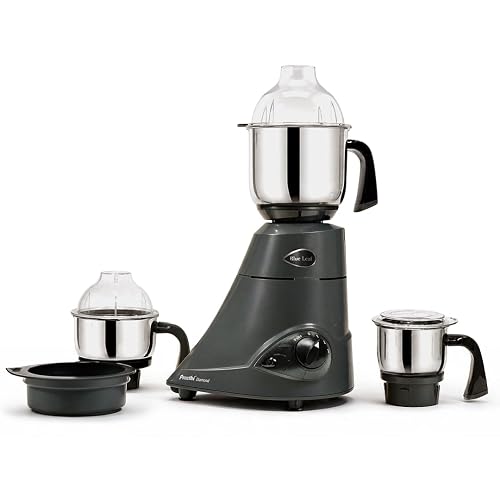
Preethi Blue Leaf Diamond 750 W, 3 Jars + Flexi Lid
Best for: Small households that grind in small batches
Key specifications
- Specification 1
- 750 W
- Specification 2
- 3 jars (1.5 L
- Specification 3
- 0.5 L
- Specification 4
- 0.4 L)
- Specification 5
- Flexi lid
Pros
- The flexi lid converts the 1.5 litre jar down to 1 litre, so you can grind a small batch without it disappearing under the blades.
- A 0.4 litre jar that is genuinely useful for chutney and ginger-garlic paste.
- The cheapest 750 W set here from a brand with real service coverage.
Cons and checks
- Three jars and no juicer; and 750 W is the sensible maximum for this price, not a heavy-duty motor.
Guide price: ₹2,999. Checked 4 November 2026; confirm the current price on Amazon.
750W or 1000W: what the number buys you
Wattage is the motor’s power input. More of it means more torque under load, which matters when the jar is full of soaked rice and urad dal, or when you grind a tough dry masala without stopping. It does not make a badly designed jar grind evenly.
For a home kitchen, 500–750W handles everything — dal, chutney, masala, small batches of batter. The step up to 1000W is worth paying for in two situations: you grind idli or dosa batter regularly for a family of five or more, or you grind large quantities of dry masala where the motor runs long and hot.
The specs that matter more than the wattage: a 100% copper-wound motor, ball bearings rather than a bush, a thermal overload cut-out, and stainless steel jars with a proper lid lock. A mixer that keeps running for 30 minutes without the motor getting hot is a better machine than one with a bigger number on the sticker.
| Motor | Handles | Buy it if |
|---|---|---|
| 500–600W | Daily chutney, small masala batches, light wet grinding | One or two people, no regular batter grinding |
| 750W | Regular dal, chutney, masala grinds and medium batter batches | The standard Indian family kitchen |
| 900–1000W | Long batter grinding, large dry-masala batches, continuous use | Big families, or weekly idli/dosa batter in bulk |
The jars decide half the purchase
A usable set is a 1.5 litre wet jar, a 1 litre dry/multipurpose jar and a 0.3–0.5 litre chutney jar. Those three cover almost everything. The fourth jar in a "4 jar" package is usually a juicer jar — useful if you actually make juice, otherwise it is storage you never use.
Jar size also sets the minimum batch. A 1.5 litre jar cannot grind two tablespoons of coconut for chutney — the blades miss it. That is why the chutney jar matters more than the biggest jar in the box, and why a "flexi lid" that converts a 1.5 litre jar down to 1 litre is genuinely useful.
| Jar | Capacity | Grinds |
|---|---|---|
| Wet jar | 1.5 L | Batter, gravies, large wet batches |
| Dry / multipurpose | 1 L | Dry masala, coffee, suji, small wet batches |
| Chutney jar | 0.3–0.5 L | Coconut chutney, ginger-garlic, small quantities |
| Juicer jar | 1–1.5 L | Juice and blending — optional for most kitchens |
What actually kills a mixer
Overfilling the wet jar is the most common cause of failure: the motor is asked to move more batter than it was built for, overheats, and the winding gives out first. Fill to the printed maximum line and grind in batches instead.
Running dry masala too long is the second. Dry grinding generates heat quickly, and the blades and jar get hot enough to damage the seals. The manual’s duty cycle — the number of minutes the mixer can run before resting — is the spec most people skip, and it is the one that decides whether the machine lasts five years or two.
Buy from the brand’s own store on Amazon rather than a marketplace seller for these: service centre coverage in India is what saves a ₹3,000 purchase, and a grey-market unit with no local service is worth nothing when the motor fails in year two.
Using it properly
Never wash the motor base or let water near the coupler — wash the jars, wipe the base. Dry the blade assembly before storing so the shaft does not seize.
Run dry masala in short pulses rather than one long grind: it keeps the powder from heating and gives a more even texture. And if the mixer smells of burning during the first few uses, that is the protective varnish on the motor winding burning off, which the Philips manual explicitly says is normal.
Questions we get asked
Is 750W enough for idli and dosa batter?
Yes, for home-sized batches. A 750 W mixer will grind batter for a family of four if you do not overfill the jar and give the motor a rest between batches. Step up to 900–1000 W only if you grind large volumes regularly.
Should I pay more for 1000W?
Only if you grind batter in bulk or dry masala in quantity. For chutney, small masala batches and everyday gravies, the difference is small — motor build, jar design and overload protection matter more.
Which jar should I use for chutney?
The smallest one — usually 0.3–0.5 litres. A big wet jar cannot pick up a small quantity of coconut or ginger, so the blades spin over it instead of grinding it.
Why does a new mixer smell of burning?
The protective varnish on the motor winding burns off during the first few uses. Philips states this in its manual. If the smell continues after several uses, stop and get the unit checked.
How long can I run a mixer continuously?
Follow the duty cycle in the manual — usually a few minutes on, then a rest. Some models, like the Sujata Dynamix here, are rated for extended running; most others are not, and overrunning them is what burns out the winding.
Want more recommendations?
Browse every buying guide — kitchen, home, phones and everyday tech, compared by price and build.
Browse all buying guides